《TIA Thoughts & Impression 》
《TIA Thoughts & Impression 》
Archer Chiu, TIA Research Fellow, 2024.08.01
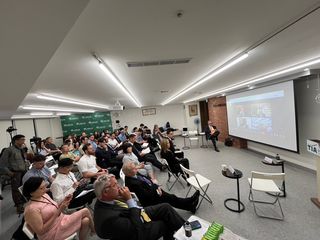
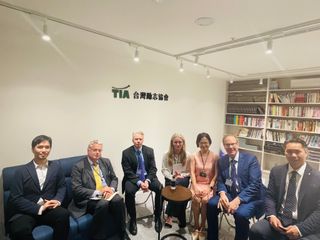
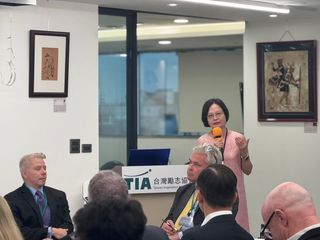
Right after the first day of the groundbreaking Inter-Parliamentary Alliance on China (IPAC) meeting in Taiwan, Taiwan Inspiration Association (TIA hereafter), a civil society group based in Taipei, held its first ever International Symposium : China’s Bad Governance Model for Africa - Alternative Visions where many participants of the IPAC meeting took part in.
This International Symposium focused on the investment projects and international cooperation projects of People’s Republic of China (PRC hereafter) in Africa, especially those associated with the Belt and Road Initiative (BRI hereafter) boasted by Xi Jinping and the Chinese state apparatus. Throughout the past years, many of the projects have been highly criticized by the local Africans, the international community and even some Chinese scholars. TIA’s symposium served as a platform where various parties with diverse perspectives from around the globe delved into this vital issue and shared their firsthand experience from a wide array of different standpoints.
To open the insightful and informative TIA International Symposium where prominent speakers abound, multiple speakers including the Honorable Tim Loughton, retired Member of Parliament of the United Kingdom and the Honorable Eric Schultz, former U.S. Ambassador to Zambia shared their personal experience in Africa. Through the speakers’ sharing, we the audience realized how Djibouti voted in support of PRC in the United Nations on accusations of China’s human rights violations and that Djibouti even denied those critics to enter its territory.
In addition, the speakers also illustrated that China’s BRI projects in Africa have had detrimental impacts on the local communities and that the locals are suffering from their dire consequences. For instance, China has been using what could only be described as Debt-trap Diplomacy as a tool to project its power on the African continent. It has been sending Chinese workers to BRI projects in African countries rather than creating new jobs such as subcontractors and construction workers for the locals. Furthermore, the quality and durability of the infrastructures and roads built have not been ideal. To make matters worse, the speakers believed that China has been bribing politicians and policy makers in Zambia and other African nations. When it comes to the Democratic Republic of the Congo (DRC) speakers also noted that it ought to be able to thrive with its rich natural resources; however, it hasn’t been the case as PRC entered the playing field with its exploitative measures. All of the above-mentioned problems have plagued African countries with more corruptions and poverty.
One researcher highlighted the fact that the Chinese Communist Party (CCP hereafter) has always regarded Democracy as a threat, something that could endanger the party’s existence and legitimacy as well as the continuation of the PRC regime. Some speakers warned the west and the U.S. in particular that a more pragmatic approach as well as a coherent and comprehensive grand strategy should be employed in terms of African affairs. These intellectuals and practitioners believed that a value-based idealist approach on its ownwould not be sufficient in countering PRC’s operations and massive influence in Africa.
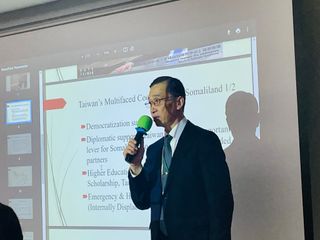
Before ending the TIA International Symposium, various seasoned diplomats such as The Honorable Mohamed Hagi, Representative of Somaliland to Taiwan and his counterpart the Honorable Allen Lou, provided insights into a mutually beneficial relationship between Somaliland and Taiwan. The speakers highly praised the Taiwan Model and shed light on how certain practices of Taiwan’s diplomatic policy towards Africa was inspired by the scholarship programs offered by the U.S. They claimed that Taiwan benefited immensely by the U.S. scholarship programs which allowed Taiwanese talents to acquire further knowledge, skills and expertise on American soil. As for now, Taiwan has become the provider of scholarship programs which grant African talents to pursue their degrees in Taiwan. This has in turn benefited African nations and local communities as the graduates have gained abundant knowledge and skills in medicine, technology and other disciplines before returning to their hometown to contribute their professional services.
To sum up, the speakers have raised concern about PRC’s investments and operations in Africa which have already had significant negative impacts on various grounds, such as economic well-being of the local communities, democratic processes, and global geopolitics. They also showcased how Taiwan’s meaningful participation in Africa could be beneficial to different stakeholders involved and that the Taiwan Model could be a possible alternative.
最新文章
其他活動心得分享