《TIA Global Perspectives》
《TIA Global Perspectives》
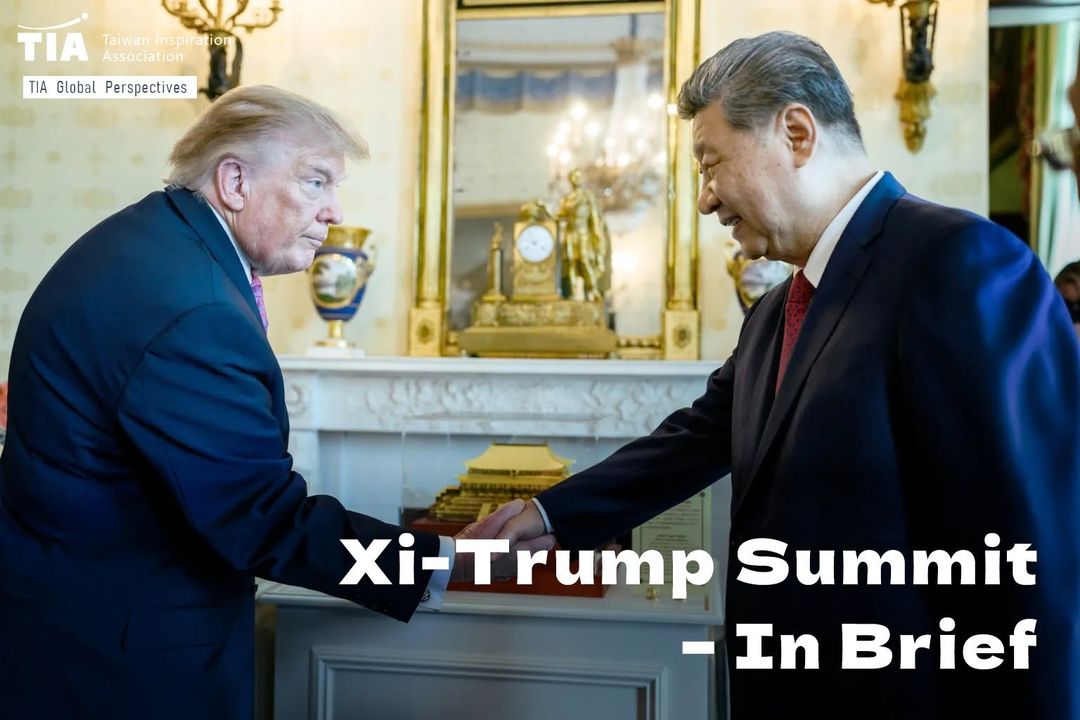
Xi-Trump Summit – In Brief
─ TIA 實習生 Jude Hill
———
🎈The Visit
On September 23, US President Donald Trump and Chinese President Xi Jin-Ping met in Washington DC for what the White House has described as an “historic meeting” (“Fact Sheet,” 2026). Notably, this is the first time in 10 years that such a meeting between the two major powers’ leaders has taken place in Washington (Yilek et al., 2026). The tone of the summit was conspicuously ceremonial with President Trump literally rolling out the red carpet for his Chinese counterpart (Nicholas, 2026) and holding a lavish state dinner in Xi’s honor, much to the chagrin of some members of his own party (Bolton, 2026). Presidents Trump and Xi apparently discussed an array of topics from AI, which President Trump has rebranded as “Super Intelligence,” (Ahn, 2026) to trade, but details remain sparse, and dueling press releases make it difficult to determine what exactly was agreed upon. However, some information has been made publicly available by both parties.
———
🎈What Was Discussed?
On the AI front, both leaders agreed to maintain dialogue between their two countries and scheduled additional talks for the end of November (Bicker, 2026) The two also agreed to a “trade truce” between the US and China entailing tariff reductions on $30 billion in Chinese imports to the United States, which China has reportedly agreed to match. While the Whitehouse stated that Beijing agreed to import at least 10 million metric tons of coal from the US between 2027 and 2028, Beijing has yet to corroborate this statement. China did, however, agree to tighten export regulations on chemicals that are used to manufacture illegal drugs imported to the United States (China Expands Export Controls on Drug Precursors Ahead of Trump-Xi Meeting, 2026). Finally, President Xi agreed to lease two giant pandas to the Atlanta Zoo (Bicker, 2026).
———
🎈What Was Left Out?
Perhaps more important than what was discussed at the lavish summit between the two world leaders is what was left out. While the White House stated in its press release that Trump and Xi would “continue to work on” (“Fact Sheet,” 2026) the issue of rare earth supplies to the United States, no agreements were made in this area. In the realm of security, Trump failed to secure any concrete guarantees from Xi regarding the cessation of Chinese support for Iran. The White House also made no mention of Taiwan, or its pending $14 billion arms deal (Wu, 2026) with the island, in its press release (“Fact Sheet,” 2026), while the PRC stated, for its part, that it hopes the US will “adhere to the correct position of opposing ‘Taiwan independence’” (President Xi Jinping Holds Talks with U.S. President Donald J. Trump, 2026). Confusingly, Ambassador to China David Perdue communicated to Fox News that Trump offered to sell weapons to the PRC, but State Department officials later denied that the US plans to sell weapons to China, clarifying that US law prohibits weapons sales to the PRC (Khan, 2026).
———
🎈Key Takeaways
What the Trump-Xi summit lacked in substance, it made up for in theatrics, which, for the two world leaders, may have been the target. For President Trump, the meeting between himself and Xi presents an opportunity to assuage the fears of American consumers who are feeling the bite of tariff and Iran War related inflation. Additionally, Trump can present his meeting with Xi as an indicator of the success of his “America First” style of foreign relations, which emphasizes President Trump’s personal relationships with world leaders over the US’s historical and institutional ties. Nevertheless, it remains to be seen if the meeting will produce the results that President Trump is hoping for.
Meanwhile, the benefits of the meeting to Chinese President Xi Jin-Ping are far clearer. Xi is currently serving his third term as leader of the People’s Republic of China, and while the embattled President has presided over a period of extraordinary economic growth for his country, continued growth is far from guaranteed. Like much of Asia, China is an aging country that is vulnerable to the economic impacts of the Iran War and other conflicts like it. Xi can point to his meeting with Trump as evidence that his project to remake the world order to the advantage of China has largely paid off, despite the short-term risks. For Xi, this meeting is also a propaganda victory on the global stage. Xi can portray China as a reliable partner and an equal to the US while simultaneously eroding the confidence of traditional US allies in the Asia-Pacific -- including Taiwan -- in the US’s commitment to their security.
———
🎈Taiwan’s Perspective
Luckily for Taiwan, while the Trump-Xi meeting was arguably a propaganda coup for the PRC, fundamental changes to the US-Taiwan security relationship are unlikely. Support for Taiwan in the US is structural and largely bi-partisan while opposition to the PRC is similarly universal. The planned $14 billion arms sale to Taiwan is still likely to more forward, though perhaps not quickly, and despite Ambassador Perdue’s statements, the US will not sell arms to China. Still, Taiwan would be wise to diversify its international relationships in response to an increasingly volatile American executive. While the US and its allies did not lose much from the Trump-Xi summit, they did not gain much either, except for the pandas, of course.
———————————————————————————
🎈References
Ahn, A. (2026, September 30). Trump Signs Executive Order Renaming AI to ‘Super Intelligence.’ Politico. https://www.politico.com/....../trump-signs-executive......
Bicker, L. (2026, September 28). Trump-Xi Summit: What Wasn’t Said Might Matter the Most. BBC. https://www.bbc.com/news/articles/cxp84g2ly1mjo
Bolton, A. (2026, September 25). GOP Senators Dismayed by Donald Trump Embrace of Xi Jinping After China Helped Iran Target US troops [Text]. The Hill. https://thehill.com/....../6110545-gop-senators....../
China Expands Export Controls on Drug Precursors Ahead of Trump-Xi Meeting. (2026, September 23). NBC News. https://www.nbcnews.com/....../china-expands-export......
Fact Sheet: President Donald J. Trump Advances a Fair and Reciprocal Relationship with China While Hosting Historic State Visit. (2026, September 26). The White House. https://www.whitehouse.gov/....../fact-sheet....../
Hvistendahl, M. (2024, October 19). Want to Rent a Panda? Here Are 5 Things China Demands in Return. The New York Times. https://www.nytimes.com/....../panda-rental-contracts.html
Jiang, S., Ronald, I., Valerio, M., & Boyette, C. (2026, September 26). 2 Giant Pandas Arrive at Zoo Atlanta in a Rare Loan From China. CNN. https://www.cnn.com/....../two-giant-pandas-leave-on-a......
Khan, M. (2026, September 29). US Officials Deny There are Plans to Sell Weapons to China. ABC News. https://abcnews.com/....../us-officials....../story......
Lukpat, A. (2022, February 13). 50 Years Later, Some Question Value of U.S.-China ‘Panda Diplomacy.’ The New York Times. https://www.nytimes.com/....../us-china-panda-diplomacy.html
Mott, M. (2006, March 13). Panda “Rent” Too High, U.S. Zoos Say. National Geographic. https://www.nationalgeographic.com/....../united......
Nicholas, P. (2026, September 25). Trump Rolls Out Red Carpets For Xi Jinping, Though He Has Portrayed China as a Global Menace. NBC News. https://www.nbcnews.com/....../trump-rolls-red-carpets......
President Xi Jinping Holds Talks with U.S. President Donald J. Trump. (2026, September 25). Ministry of Foreign Affairs People’s Republic of China. https://www.mfa.gov.cn/....../202609/t20260925_12031181.html
Ryan, J. (2019, May 18). Why Paying for Pandas is Not So Black and White. BBC. https://www.bbc.com/....../20190516-why-paying-for......
Wu, H.-Z. (2026, September 29). Taiwan Says it Remains in Talks With the US Over Arms Sales. AP News. https://apnews.com/....../taiwan-us-arms-sales-trump......
Yilek, C., Watson, K., & Walsh, J. (2026, September 25). Trump-Xi Visit Wraps Up With Few Achievements Announced. CBS News. https://www.cbsnews.com/....../trump-china-xi-jinping....../
最新文章
TIA Thoughts & Impression